
Opinion Editorial: Students fight for their Non-traditional Peers
With the ASUN elections heating up, it is a time for student leaders to hear the voices of all students on campus. Non-traditional students play an active part on the Nevada campus; they sometimes fade into the background of student life because they have different priorities than their millennial student peers.
The Serve On Student Veterans of America Campaign, which through a national competition, is working to raise awareness and create dialogue about the importance of non-traditional students such as Student Veterans at the University of Nevada, Reno.
The university is one of the top military friendly schools paving the way for resources and tending to the wants and needs of nontraditional student veterans.
As a little girl my mom would make me go up to men and woman in military uniform and say, “Thank you for your service” to show appreciation and support for those who fight for our country. But research shows this isn’t exactly what student veterans at the university want from their student and administrative peers.
The student-ran campaign found that student veterans want to be recognized for continued service in their families, through their education and in their community. This reaches the very heart of the Serve On Student Veterans of America movement.
If we Serve On as a university community and listen to the needs of student veterans you will find that priority registration, VetSMART and career programing is at the forefront of what student veterans want to see from their administration and student leaders.
The university is one of the only colleges in Nevada that does not have priority registration for student veterans. Student Veterans tend to be older, with families and jobs so having priority registration will greatly benefit them due to the time constraints and GI Bill. The GI Bill pays for their education and if student veterans are unable to get four classes that pertain to their major their GI Bill is reduced. The GI Bill has provided the education for 14 Nobel Prize winners, three Supreme Court justices, three presidents, a dozen senators and two dozen Pulitzer Prize winners. Having priority registration will allow student veterans to impact the economy faster than a typical student.
VetSMARTs Veterans Service’s and Vital initiative’s program strives to inform faculty and staff at the University to better understand the veteran and military culture at the University. Currently there are only 72 faculty at the University who have been trained about the student veterans, a small number, that seemingly calls for more faculty to know about vet smart and the benefits that it will have on the student veteran community.
Career programming is the main interest for student veterans on the University campus. Student veterans request that during their time in college they would appreciate different networking events that can increase their ability to get a job in the future. Networking and career job fairs specific for nontraditional students, will provide them with the necessary means of support from their peers.
The Serve On campaign strives to increase awareness on the University of Nevada college campus and in the Reno community about veterans who are students, as well as increasing the support and networks for these deserving individuals.

University’s Debate Team kicks off Earth Day festivities with public debate
Public Bike Program at the center of the community debate presentation in an effort to spark environmental and conservation dialogue
The Nevada Debate Union, part of the Department of Communication Studies in the University of Nevada, Reno’s College of Liberal Arts, is hosting a public debate and awards ceremony to end the debate season.
“This year’s team had one of the strongest finishes in school history,” Phil Sharp, debate team coach and forensics director of the College of Liberal Arts at the University, said. “Much of the success came at the end of the year, and it was exciting to watch a team reach its peak in their last month.”
The Nevada Debate Union and the University Debate Team join forces with the Earth Day committee to offer a free, public debate held at 6 p.m., Thursday, April 21, in the Joe Crowley Student Union Theatre.
Related Story
Arboretum Board celebrates Earth Day, Arbor Day and more, check out events held in April and May.
In the spirit of Earth Day, the team will discuss the funding of a public bike program that will allow students to “check out” a bike for commuting around town or on campus. Each year, the team selects a topic related to an environmental justice issue and they stage a performance for students, staff, alumni and community members. The debate team has put on a public debate during the week of Earth Day for nearly six consecutive years, offering the community a chance to watch a top-ranked competitive debate team in action.
“We are excited to be a part of a campus-wide celebration of an important day,” Sharp said. “Our goal is to help spread awareness and spark a dialogue about important environmentally based controversies.”
The team will also perform an abbreviated version of their debate on the stage in front of the Joe Crowley Student Union at 10 a.m., Friday, April 22. They will kick off the official Earth Day events, happening from 10 a.m.-2 p.m., and include a sapling giveaway, a dumpster dive, yoga on the grass, a visit from the Bag Monster, guest speakers, performers, and various clubs and community organizations giving out information and Earth Day gifts.
To close out the year, the University’s Department of Communications Studies will hold the Nevada Debate and Oral Communication Awards. During the ceremony, the William J. Cashill Scholarship and the Robert S. Griffin & W. Clark Santini Awards and Scholarships will be granted to outstanding students of the debate team. Throughout the year, students accumulate trophies and plaques to represent their efforts and achievements. This ceremony offers them the opportunity to share their accomplishments with faculty, administration, alumni and supporters. The reception starts at 4:30 p.m. and the ceremony at 5 p.m., Monday, May 2, in the Joe Crowley Student Union Great Room on the fourth floor.
“It is bittersweet to see some of our students graduating, but we are excited to have the core of our team back for another season,” Sharp said. “With five of the six debaters who made it to elimination rounds at nationals returning, we expect to have a great season next year.”
W. Clark Santini Award
Named after W. Clark Santini, a former student of the University and debate team member, the W. Clark Santini Cup is granted each year to a person who, through oral communication, has brought significant benefits to the community as a whole. Santini was a visible community activist involved in the creation of Rancho San Rafael Park and protection of the Truckee River.
This year’s Santini Cup winner is Carina Black. She has been the executive director for the Northern Nevada International Center for 17 years and has brought more than 10,000 international visitors to Reno. The contributions she’s made to the center and northern Nevada through oral communication will be recognized.
Robert S. Griffin Medal
The Robert S. Griffin Medal is awarded to the top member of the Nevada Debate Team each year. Given in honor of Robert Griffin, the first director of forensics at the University, the award recognizes a student who has achieved greatness both in and out of debate rounds, acts as a leader on the team and conducts themselves in a manner that honorably represents the University and the debate team. The award winner exemplifies the commitment, charity and professionalism that Griffin taught to generations of students and members of the debate team at the University.
William J. Cashill Scholarship
Also recognized at the event will be the recipients of the William J. Cashill Scholarship. Cashill was a member of the debate team from 1934-1937 and won the Griffin Medal in 1937. He used his oral communication skills in his law practice and as a distinguished member of the community.
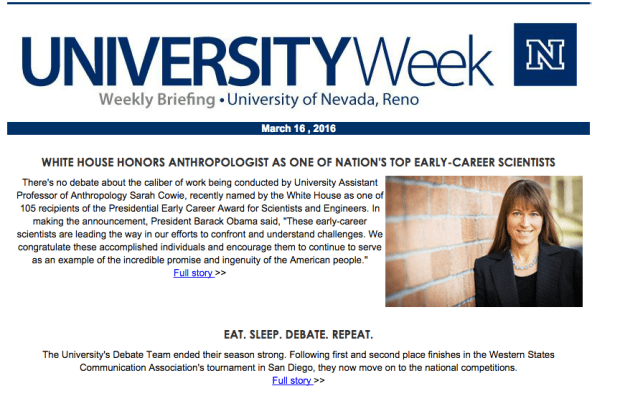
Eat. Sleep. Debate. Repeat.
Nationally ranked debate team prepares for nationals after a momentous win in San Diego
The University of Nevada, Reno Debate Team ends their season strong claiming first and second place in the Western States Communication Association’s tournament in San Diego in early March. Four of the 20 members of the Intercollegiate Debate Program helped improve the squad’s overall No. 15 place ranking before the national tournaments.
The National Parliamentary Tournament of Excellence, a tournament for the top 54 teams in the nation, takes place at El Camino Community College starting March 14, The National Parliamentary Debate Association tournament is held March 18 through 21 at Cal State Long Beach. The NPDA is the largest intercollegiate debate organization in the United States priding itself on fostering knowledgeable and engaged citizens while bringing unique debate styles from across the country. Nevada Debate will take six teams to the NPDA Championships.
“This year in particular, I am encouraged by the team’s willingness to work,” Phil Sharp, the debate team coach and forensics director in the College of Liberal Arts at the University, said. “Their desire to do better and to improve are the keys to success that will lead both partner teams to hopefully finish strong in the national tournament.”
The squad’s top-two teams entered the WSCA tournament in San Diego this month hoping to improve their standings before the national tournament.
The squad’s top duo Grace Miller and Jakob Christensen, pulled a perfect tournament finishing as the first and second speakers and went 5-0 in the preliminary rounds, and won both the quarters and semi-finals on 3-0 decisions.
The University’s other top debate duo, Daniel Armbrust and Evelyn Valencia-Rodriguez, began the tournament in San Diego dropping rounds one and two, but they quickly bounced back to make it all the way to the final rounds joining their teammates as unofficial co-champions of the tournament.
Because of the four-month long season success and qualifying-tournament wins, the two teams jump in the national standings. Both Miller and Christensen sit at sixth place while Armbrust and Valencia jump to the No. 29 spot, but before the final tournament, weeks of research, practice and dedication fill the time of the Debate team.
“In the weeks leading to nationals, we go to school, eat, we spend hours at debate practice and researching, go home, sleep, rinse and repeat,” Armbrust said. “If you have work, throw that in too.”
Students dedicate many hours and days to practice and competitions year round, beginning with debate camps during summer, four-hour weekly meetings/practices during the academic year to hone their skills, nine regional competitions – 27 competition days – plus nationals, a weekend-long prep session before nationals, a public debate in the spring, year-end gatherings and volunteer judging at local high school competitions.
The debate topics for the national tournament are comprised of five controversial issues, which include: the United States federal government should substantially increase its investment in transportation safety infrastructure; the United States federal government should substantially increase oversight of, or restrictions on, its electronic surveillance; the United States federal government should substantially increase its support for rural development in the United States; the United States should establish a policy to facilitate and/or expedite the repatriation of cultural property; and the United States federal government should consent to be bound by, and implement either economic, social and cultural rights or convention on the rights of persons with disabilities.
“We split up the research between our partnerships, but we also have the support of our team,” Christensen said. “So, we come up with what strategies that we want to use on all of the resolutions, then farm out parts of the research to people who are willing to help us out.”
Although there are only two teams competing in the national tournament, the rest of the squad dedicates their time researching for the two teams allowing them to put together strong arguments.
“We have a family vibe this year,” Miller said. “The rest of our team has been extremely helpful in the prep room. Since it is only the four of us going, having extra help with researching is them being awesome teammates.”
Beyond tournaments, University debaters have success both inside and outside of the classroom.
“The cool thing about debate is that we spend weeks conducting research and analyzing data,” Amburst said. “The skills we learn are very applicable in most of my classes.” Miller agreed.
“Professors think very highly of debate,” Miller said. “They always say, ‘you’re a debater so you will probably do well in this class.’ As I’ve progressed through debate, I have found that my professors enjoy engaging with me and have seemed more willing to write letters of recommendation for scholarships and job applications.”
“The ability for debaters to think on their feet, think critically, research effectively and argue points with a goal in mind is looked at by employers with high regard,” Sharp said.
“For them to use what they learn in practice, at the tournaments and from each other will ultimately lead to opportunities in the future.”
During Sharp’s first season, he coached the University’s Max Alderman and David Pena to an unprecedented first place at both of the national tournaments in 2009, the NPDA and the National Parliamentary Tournament of Excellence. In 2014, the University’s Nevada Debate Union, a student-run club part of the Department of Communication Studies, was selected by the Associated Students of the University of Nevada as the Outstanding Club of the Year, and two of the top debate team members were selected as the Outstanding Club Leaders of the Year, for both the men and women’s categories. To top the season, the squad captured the 2014 Season Sweepstakes Championship Title, ranking first out of 189 schools. In 2015, Sharp was named ASUN Club Advisor of the Year.
Catch the University team in action during the Nevada Debate Union’s annual public debate, free and open to the community Thursday, April 21. The environmentally themed debate begins at 6 p.m. in the Wells Fargo Auditorium in the Mathewson-IGT Knowledge Center.
University anthropology professor honored with prestigious Presidential award
Sarah Cowie awarded for her work surrounding native and non-native American collaboration
University of Nevada, Reno Assistant Professor of Anthropology Sarah Cowie was recently named one of 105 Presidential Early Career Award recipients for Scientists and Engineers by United States President Barack Obama. The Presidential Early Career Award is the highest honor awarded by the United States government to scientists and engineers at the early stages of their career, coordinated by the Office of Science and Technology policy with the Executive Office of the President. Awards are given to outstanding scientists and engineers in the early stages of their independent research and show exceptional potential for leadership at the frontiers of scientific knowledge during the 21st century. Awardees will be recognized at a ceremony in Washington, D.C. this spring.
“These early-career scientists are leading the way in our efforts to confront and understand challenges from climate change to our health and wellness,” President Obama said in the official news release sent last month. “We congratulate these accomplished individuals and encourage them to continue to serve as an example of the incredible promise and ingenuity of the American people.”
Cowie, with the University’s College of Liberal Arts, received the career award for her earlier work on the archaeology of capitalism and industrial archaeology. It was also awarded based on the recent collaborative archaeology project to preserve the Stewart Indian School in Carson City, conducted in partnership with the Nevada Indian Commission and the Washoe Tribal Historic Preservation Office, with further participation from numerous tribal members who contributed tremendously to the research.
In addition to the Presidential Early Career Award, Cowie also received a research grant from the Department of Defense Army Research Office. The grant gives Cowie the opportunity to continue the second phase of her research, which explores strategies for humanizing respectful heritage consultation between American Indian tribes and the federal government.
“I am glad that this award recognizes collaborative work with native and non-native people, to recognize how important it is to explore shared heritage,” Cowie said. “I am confident the partnership between my research team and tribal organizations on the project helped with the PECASE nomination, which includes public outreach and recruitment of diverse students among the criteria for evaluation, in addition to the research itself.”
Along with her specific grant work with the Department of Defense, Cowie was recognized for her efforts in historical archaeology of the American West and Southeast. She has done extensive research in social theory, power relations, structure and agency, landscapes, cultural resource management and decolonizing methods, archaeology of working communities, industrial archaeology, and collaborative archaeology.
“Anthropology addresses human diversity by combining both quantitative and qualitative data, and archaeology does this through a material lens,” Cowie said. “The PECASE is a STEM award, and my work does involve GIS, geochemistry, quantitative methods and such. But the theoretical framework that drives my research is based on post-modern theories, and much of the data is qualitative, for example, archival research, multi-vocal observations and ethnographic work.”
“This is an outstanding achievement and an honor for the University, as well,” University President Marc Johnson said. “I recall following her ‘Old Indian School’ dig a few years ago in Carson City. Congratulations to Sarah for this impressive award.”
Cowie became interested in anthropology at a young age. After growing up in Mississippi during the 1970s and 1980s, she struggled to understand the conflicts among diverse people. This led her to become interested in interpreting behaviors from the things people left behind and learning how they influence modern interactions.
Throughout her career in anthropology Cowie has received a multitude of awards including the John L. Cotter Historical Archaeology Award from the Society for Historical Archaeology; the Hunt Postdoctoral Fellowship and Dissertation Research Award from the Wenner-Gren Foundation; the Raymond H. Thompson Fellowship Endowment from the Arizona State Museum; the William Shirley Fulton Scholarship; the Graduate College Fellowship and Emil W. Haury Educational Funds from the University of Arizona.
Media Coverage:
University Theatre and Dance stun in two national conferences
Department actors and dancers accomplish strong finishes in two high-profile performances
The University of Nevada, Reno’s Department of Theatre and Dance recently produced strong student finishes at the Kennedy Center American College Theater Festival competition and The American College Dance Association conference.
The American College Dance Association conference is a venue for many college and university dance programs to perform outside their own academic setting and for students to be exposed to the diversity of the national college dance world.
Do to the outstanding performance at the conference of “Ordinary Things” – a contemporary dance work with a comedic tone – the six University dancers were chosen to perform at the Gala concert, which showcased the best dance works from the conference. Of the 40 dances performed, this was this first time that the University was selected in the top 11.
“This is a huge honor for University theatre and dance,” Rosie Trump assistant professor of dance at the University, said. “Having our dance received this well at the conference speaks to the high caliber of work the faculty and students are doing. It also means that we stack up very well against our regional peers.”
The four-day conference took place at Scottsdale Community College in Scottsdale, Arizona. Students attended from 26 colleges within Arizona, Utah, California and Nevada, and they performed, attended masters classes and watched concerts together.
“The University’s dance minor has been rapidly growing in interest, scope and size for the past few years,” Trump said. “The students are striving for excellence and the faculty are supporting the students’ interests by offering the opportunities of diverse and rigorous classes, world-renowned guest artist residencies and master classes, and semester dance productions of students, faculty and guest artists.”
In addition to dance, two student actors attended the Kennedy Center American College Theater Festival in Denver, Colorado. After watching the student-produced play adapted from the 1960’s novel “To Kill a Mockingbird,” Julius Funches, who played Tom Robinson, and Keely Cobb, who played Scout – and also attended the dance conference, were personally selected by a representative from the Kennedy Center to participate in the Region VII Festival. They competed in three rounds, performing three pieces in each round. Funches made it to the final round out of 300 hundred actors, who came from Alaska, Colorado, Idaho, Montana, northern California, northern Nevada Oregon, Washington and Wyoming.
“In both theater and dance, we are training our students to do really good work and it is exciting to see that they are getting acknowledged for their talent and their skill,” Robert Gander, theater and dance department chair at the University, said. “I think it is a great opportunity for students to go to Arizona and Colorado and look at the quality of work that the other people are doing on a national scale, and to see how well they compare. We are very proud of our students.”
Forum for Excellence welcomes award-winning journalist Naomi Klein to the University
Open to the community, Klein will present world issues including capitalism and global warming
Award-winning journalist, syndicated columnist and best-selling New York Times author Naomi Klein comes to Nevada to present at the University of Nevada, Reno College of Liberal Arts’ annual Forum for Excellence at the Church Fine Arts, Nightingale Concert Hall, from 7-8:30 p.m., Thursday, Feb. 11 .
Klein’s presentation is open to the University and Reno community as she discusses the connection between global warming and capitalism.
Her presentation is coming from the momentum of her critically acclaimed new book, This Changes Everything: Capitalism vs the Climate. This Changes Everything is the 2014 winner of the prestigious Hilary Weston Writers’ Trust Prize for Nonfiction and was an instant bestseller when published in September 2014. It debuted at No. 5 on The New York Times list and was named to multiple Best of 2014 lists, including The New York Times 100 Notable Books of 2014. In addition, This Changes Everything: Capitalism vs the Climate, was also shortlisted for the 2015 PEN Literary Awards in the nonfiction category.
“We like to present speakers who engage audiences in discussions with a focus on critical thinking,” Larry Engstrom, interim dean of the College of Liberal Arts, said. “Of course, that is one of our main goals in College of Liberal Arts classrooms as well: encouraging students to think critically.
The Forum for Excellence brings internationally recognized figures to the University campus in hopes of inspiring, teaching and giving knowledge to the community. The Forum for Excellence has held many notable guests through the years including historian and political commentator Michael Beschloss, American author, storyteller and radio personality Garrison Keillor and author and commentator for National Public Radio’s “Morning Edition,” Frank Deford.
“The Forum for Excellence was created in 2000 by professor and dean emeritus Robert Mead,” Engstrom said. “Since then, we have presented many speakers that have offered insights and new perspectives on critically important topics, often relevant to current issues facing the world. With Namoi Klein, we think we have hit a home run in that regard.”
Klein’s visit is sponsored by the College of Liberal Arts. The College of Liberal Arts contains the disciplines of the humanities and social sciences, as well as the School of the Arts and the School of Social Research and Justice Studies. The departments and programs of the University’s largest college play key roles in undergraduate and graduate instruction, teaching students to develop intellectual curiosity, research skills and the ability to define and solve complex issues. The faculty in the department are nationally and internationally known for their research and creative activity.
Klein’s writing has appeared in The New York Times, The Washington Post, Newsweek, The Los Angeles Times, The Globe and Mail, El Pais, L’Espresso and The New Statesman, among many other publications. Klein is a contributing editor for Harper’s and reporter for Rolling Stone, and writes a regular column for The Nation and The Guardian that is syndicated internationally by The New York Times. She is also a member of the board of directors for 350.org, a global grassroots movement which was created to help resolve the climate crisis. In 2015, she received The Izzy Award honoring outstanding achievement in independent journalism and media. She is a Puffin Foundation Writing Fellow at The Nation Institute and a former Miliband Fellow at the London School of Economics. She holds an honorary Doctor of Civil Laws degree from the University of King’s College, Nova Scotia.
Night of all Nations includes kick-off parade during 2015 International Education Week
14th annual international week proves the University of Nevada, Reno is more global than ever
With the intention to educate, prepare, and inspire the community to experience the world, the Honors Program, the Office of International Students and Scholars, the Intensive English Language Center, the University Studies Abroad Consortium and several other University units have partnered up to put on the 14th annual International Education Week. The Honors Program provides students who are both academically talented and highly motivated with an elite undergraduate education and the USAC gives students the resources to study abroad The International Education Week is a nationwide event encouraged by the U.S. Department of State. It begins Monday, Nov. 16, and runs through Saturday, Nov. 21. The week is packed with events to show how international the campus is by celebrating the different cultures and backgrounds of students, staff and faculty.
“International Education Week is an opportunity for the entire campus to get involved whether it be to learn about different cultures or get more information about studying abroad,” Alyssa Yocom, a junior Honors Program student who studied abroad in Bilbao, Spain, said.
Open to the community, International Education Week’s most notable events include the Parade of Nations and the 33rd Annual Night of All Nations. Seventy different cultures will be represented in the The Parade of Nations The 33rd Night of all Nations will give the community the opportunity to experience the culture of more than 20 countries, where many exhibitors will be serving food and presenting their traditions. There will be dancers and musicians who will entertain the crowd and attendees will be able to participate in craft-making at various booths.
Students are also involved in the planning and execution of various events throughout the week, including Honors Students Discover the World nights and presentations. During these events, Honors students who studied abroad in different countries will present their experiences and offer food inspired by the cultures and places they visited.
New to International Education Week is the Student World Water Forum. The keynote speaker is Sudeep Chandra, associate professor of Biology in the University’s College of Science. Attendees will learn about water quality conservation and species, followed by a social.
“We always encourage students to go abroad to learn about the different cultures and languages of various countries,” Daniel Villanueva, professor and assistant director of the University’s Honors Program, said. “Programming such as this, and study abroad itself, give students an opportunity to educate themselves about world issues and to learn more about themselves. They become more self-reliant and gain more perspective on the United States, cultures and political systems as well.” Villanueva is also the current President of the Western Regional Honors Council.
Students continue success; receive awards for anthropology essays
University students earn 29 awards in the national Public Anthropology writing competition
The University of Nevada, Reno’s introduction to cultural anthropology class continues its winning streak after four consecutive years of garnering awards, by honoring 29 students for their writing in the Public Anthropology’s fall 2015 Community Action Project.
“This project is set up to get students to engage with an ethical situations that anthropologists are faced with today,” Louis Forline, associate professor of anthropology in the College of Liberal Arts and professor of the class, said.
The Center for a Public Anthropology is a national organization that encourages scholars and their students to address public problems in public ways. Each year, students research and write about an issue of pressing ethical concern.
“I am very pleased with the results,” Forline said. “This is a national project that teaches students about globalization and how it relates to developing nations as well as local issues. Twenty-nine students received awards for their writing and understanding, which is about 10 percent of the class. This shows how these University students have a strong understanding of this subject.”
Forline has played an integral part in the Public Anthropology’s online student community, showcasing the ability of Nevada students to learn effective writing skills while being active global citizens. He demonstrates how combining technology with cultural concerns in academic courses positively engages students to participate in the broader world beyond their academic setting, while gaining the skills needed for a productive, active life after graduation.
Forline specializes in ecological anthropology, sustainable development, nutrition and racial-ethnic studies focusing on Brazil and the United States. He has worked among the Awá-Guajá Indians since 1990, examining their contact experiences with Brazilian mainstream society and especially the transition from foraging to farming. He has also worked among urban Indians in the city of Altamira, Brazil, examining the resurgence of their indigenous identity as well as conducted environmental impact assessments of hydroelectric projects. He has also conducted nutritional studies among indigenous and peasant groups in Pará state, Brazil. Forline has two recent publications that include: his first, 2015 “The Awá-Guajá and Brazil’s expanding frontier in Amazonia: Reflecting on indigenous strides and setbacks in a globalized world.” Urban Anthropology and Studies of Cultural Systems and World Economic Development (UAS). Volume 44, Number 1-2 Spring-Summer. Secondly, 2016 “Engaging with friends and enemies: sociolinguistic implications of contact between the Awá-Guajá and their Tupí-Guaraní neighbors.” International Journal of the Sociology of Language. In press. Co-authored with Marina Magalhães. Volume 240. In press.
After writing the essays, students submit them online and each essay receives a score based on anonymous peer evaluations. They then have the option of submitting the essays to appropriate legislators and policymakers. The top 5 percent of essays with the best scores are then reviewed by the director of the Public Anthropology Project, Robert Borofsky, who determines the award winners.
“29 award winners is relatively high in relation to class size for students participating in Public Anthropology’s Community Action Project across North America. It suggests that UNR students are able to produce quality work that compares favorably with the best schools across North America especially when working with dedicated, thoughtful teachers as exists in the Anthropology Department. Furthermore UNR students have the potential to do quite well at tasks that demand high levels of critical thinking, ethical reflection, and effective writing, the potential is clearly there and, when fostered by effective teaching, can produce outstanding results,” said Robert Borofsky.
University student winners include: Phoebe Stokes, Madison Lawer, Adarsh Manoj, Caitlin Pupich, Geovanni Portillo, Roy Eakin, Nehal Mangat, Jemm Valenzuela, Jaron Bengson, Francisco Magana, Emily Buckley, Kendall Donaker, Magaly Dominguez, Cynthia McNabb, Melissa Huelsman, Brian Looper, Natasha Meier, Anthony Balko, Bailey Maberto, Gianni Pinneri, Nicola Beedle, Donald Hill Jr, Samantha Johnson, Tatiana Stafeyeva, Shane Trawick, Manon Alpe, Evelyn Hernandez, Mason Morton and Haley Wood.
Luke Tanaka named University’s Fall 2015 Herz Gold Medalist
Clark High School graduate caps academic career as top-achieving student
The University of Nevada, Reno has named Luke Tanaka the recipient of the Fall 2015 Herz Gold Medal for having earned the highest grade-point average. The Herz Gold Medal will be presented to Tanaka for his outstanding scholarship during the University’s Winter Commencement ceremony.
Tanaka, a native Nevadan and graduate from Clark High School in Las Vegas, graduates from the University at 8 a.m., Saturday, Dec. 5, with a bachelor’s of science degree in accounting and a minor in computer science and engineering. He will also “take over” the University’s Snapchat account, unevadareno, one day during the week of graduation for the monthly #PackSpotlight.
Tanaka has dedicated his time toward the betterment of the College of Business and the Reno community through extensive involvement with the Business Student Council and Circle K International. Chapter members of Circle K demonstrate fellowship and leadership development, and they collectively perform more than 1 million hours of service on their campuses and communities every year. Tanaka studied abroad in London with the Nevada Global Business Program and represented the College of Business during the Executive Mentorship Program in Seattle. In addition to his work with the College of Business, Tanaka is an Honors Program student who served on the student board of the Phi Kappa Phi honor society chapter.
“The University has a lot of opportunities and I think students do not realize that when they come in as a freshman,” Tanaka said. “I encourage students to seek out the many opportunities available on campus and pursue the things that they have passion for.”
Outside of academic pursuits, Luke has developed a passion for bicycle touring and spent last spring break biking the California coast to raise money for the Kiwanis International and UNICEF joint venture, the Eliminate Project.
Tanaka has worked at the University as a career mentor at the Nevada Career Studio and a student worker in the Advising Center.
Upon graduation, Tanaka looks forward to taking his Certified Public Accountant examination, then biking from Vancouver, British Columbia, to San Diego, Calif., and starting his career in public accounting with PricewaterhouseCoopers in the Las Vegas area next August, where he previously worked as an intern.
In addition to the Herz Gold Medal, Tanaka is recognized as the Fall 2015 Senior Scholar for the College of Business, and has named the University’s Associate Professor of Accounting Charles Carslaw as his academic mentor. Tanaka also received the IABNS scholarship, Nevada Society of CPAs scholarship, NVCPA/CAMICO scholarship, Millennium Scholarship, Kafoury Armstrong Accounting Scholarship, Presidential Scholarship and the IGT Business Scholarship. Tanaka plans to become a licensed CPA and pursue a career in related fields while actively finding opportunities to better communities through volunteerism.
The Herz Gold Medal is the University’s oldest and most prestigious award and was established in 1910 when the University was only 36 years old by brothers Richard, Carl and Otto Herz.
Funding for the award is provided by the University of Nevada, Reno Foundation and the Thelma B. and Thomas P. Hart Foundation, a Reno-based charity. The foundations continue to honor the Herz family and this tradition of recognizing excellence.
Zipcar rental service rolls onto the University campus
Students ages 18 and older now have options to rent cars for mere hours or multiple days
The University of Nevada, Reno launched a partnership with Zipcar, the world’s leading car-sharing network. Zipcar is available to students, faculty and staff ages 18 and older and community members older than 21.
“The Zipcar program on campus gives students, faculty and staff the freedom of using a car without the hassles of owning one,” Katelyn Bushey, Zipcar director of university sales, said. “We’re happy to partner with the University of Nevada, Reno to give their community a transportation option to fit their needs and their wallet.”
Participants with smartphones may download the Zipcar mobile application to make reservations, lock and unlock the vehicles and honk the horn to help locate the vehicle. Reservations can also be made over the phone or on Zipcar’s website.
Members can join the program for a fee of $15 for the first year, with rates for Zipcar vehicles on campus starting as low as $7.50 per hour and $69 per day. After the first year, members pay an annual membership fee of $25. Gas, insurance and up to 180 miles of driving per day are included in Zipcar rates, and cars can be reserved for as little as an hour or for multiple days. Two special Zipcar parking spaces are located in the parking lot on the corner of 11th and Virginia Streets.
“The more transportation demand management programs that are offered to the campus community, such as Zipcar, the more we can help decrease the drive-alone rate to campus,” Michelle Horton, parking administration manager for the University’s Parking and Transportation Services Department, said. “We ultimately would like to postpone the construction of high priced parking structures.”
With the new Zipcar program, student organizations at the University also have the opportunity to participate in the “Students with Drive” grant program sponsored by Zipcar and Ford Motor Company. The program provides students with Zipcar membership and driving credit.
Through the Students with Drive grant program, Ford and Zipcar provide $200,000 in grants to be awarded to student organizations at eligible Zipcar colleges and universities.
The program is running now through April 2016, and will culminate with a grand prize worth $25,000 in scholarships, cash and Zipcar driving. For more information and to participate in the program, students can visit http://www.zipcar.com/studentswithdrive.
Zipcar has established relationships with more than 500 universities across the country.
Muralist’s vibrant painting featured in the Church Fine Arts building
The mural serves as the entryway to the art museum that will open in 2018
Brett Flanigan, a mural artist from Oakland, Calif., recently finished a mural in the entryway of the Front Door Gallery in the Church Fine Arts building at the University of Nevada, Reno. The Front Door Gallery is an entry point for visitors coming from the Virginia Street corridor into the building and provides a pathway for visitors to enter an art museum space expected to open in 2018.
The inspiration for commissioning this mural piece stems from the mural trend that has taken hold in Reno, where the piece adds to the approximately 80 murals lining streets of the downtown area.
Born in Montana, Flanigan spent the majority of his childhood on the California coast, where he eventually majored in biology at the University of California, Santa Barbra. As he continues to express himself through painting and other art forms, his background in science shows through in the organic forms within his work. His art is on display in cities all over the world, including Hamburg, Germany; Warsaw, Poland; Brooklyn, New York; and Chicago, Illinois.
“For the piece, I chose organic shapes and very vibrant colors,” Flanigan said. “The mural does not have a name because I really wanted the art to speak for itself and allow the viewer to decide what they see.”
Murals bring attention to the businesses around them and beautify urban landscapes. It is clear to see that the mural movement in Reno has played a big part in the revival of the Midtown area, enlivening the local art scene. Bringing mural art to the University shows art of the people, creating an urban and contemporary art form for the halls of the University.
“Reno is emerging as the cultural capital of northern Nevada,” Director of University Galleries Paul Baker Prindle said in a video produced by Sheppard Contemporary and University Galleries. “We want people to make the trip from the center of the town onto campus and feel like the borders of campus have truly dissolved. We want to be integrated in with the city fabric, and I think that art is a great way to do that.”
See the mural come together in this time-lapse video of its creation, and learn more about Reno’s booming contemporary street art and graffiti scene. The video also includes interviews with Flanigan, Art Spot Reno co-founder Geralda Miller, Circus Circus Reno Marketing Director Debbi Engebritson, Baker Prindle and other talented local mural artists. Visit the Church Fine Arts building for a first-hand look at the mural and much more.
Julie Quinn Lenz continues Lenz legacy at her second graduate recital
Lenz family continues to make a musical mark on the University and Reno area
Julie Quinn Lenz, a distinguished University of Nevada, Reno graduate student and acclaimed opera singer, will perform her Graduate Recital on campus in Nightingale Concert Hall at 7 p.m., Wednesday, Nov. 25.
Lenz will perform a variety of music, including works by Rachmaninoff and Tchaikovsky, Barber’s Knoxville: Summer of 1915, and selections from Joseph Canteloube’s Chants D’Auvergne. “This is my second master’s recital and I was able to choose all the pieces that I will be performing,” Lenz said. “I am doing a lot of pieces that typically are done with an orchestra because for my career, I want to focus on orchestral concerts and operas.”
One reason that this concert is so unique is that Lenz will be singing a portion of her concert in the regional French dialect of Occitan and another in Russian. To prepare, she watches Russian operas over and over again, speaks the text like a poem and meets with Russian speakers to perfect the work. Learning to correctly pronounce Occitan has become something of a research project for Lenz.
“This makes the recital new and exciting,” she said. “One piece I will be performing for the first time is from Eugene Onegin, and it is based on one of my favorite novels.”
In addition to rehearsing for her concert, Lenz is currently pursuing her master’s degree in applied music in vocal performance under Albert R. Lee, an assistant professor of music in the School of the Arts at the University.
“I am excited because she has developed much of the program herself and she will be able to demonstrate what she has been working on,” Lee said. “Learning to sing is a very hard thing to do; for every step forward you have to take a few steps back. In addition, I am a demanding and relentless teacher and I am looking forward to seeing her continued progress.”
Lenz has been featured as a soloist with both the Reno Chamber Orchestra and the Reno Philharmonic. She has performed leading roles with the Nevada Chamber Opera and the Nevada Opera in productions such as Mozart’s Don Giovanni, Floyd’s Susannah, and Verdi’s La Traviata. Lenz is equally at home in musical theater, recently playing the role of “Florence” in Rising Tide’s production of Chess The Musical. She made her debut with the Fresno Philharmonic as the soprano soloist in Dvorak’s Te Deum in spring 2015 and was most recently named a national semi-finalist in the National Association of Singing Student Competition.
Not only has Lenz made an impact on the Reno community, the entire Lenz family is widely known in the area.
Lenz’s grandparents moved to Reno in the 1950s, although they were not musicians themselves, all of their kids went into music and have left their mark on the University of Nevada, Reno and the Reno music industry.
“All of us, at one time or another, have been a part of the University orchestra, the Philharmonic or the Chamber Orchestra here in Reno,” Lenz said. “My cousin is the concert master of both orchestras, my mom is a flutist and my dad is a cellist; I have always been surrounded by music.”
Fulbright Scholars celebrate Halloween traditions for the first time
Scholars from Argentina are welcomed to the University campus to educate students on the importance of cultural education and inclusion
As leaves begin to change and the autumn breeze briskly sweeps through the University of Nevada, Reno campus, three Fulbright Scholars from Argentina anticipate celebrating the American tradition of Halloween for the first time.
The scholars, who will be in Reno through the spring, are excited about the customs that come with Halloween and have fully immersed themselves in the holiday events, including a haunted corn maze, pumpkin decorating, Zombie Crawl and the Slaughter House Haunted House.
“It’s an exchange – we are giving you our culture and we are receiving yours as well,” Agustina Almirón said.
The Latino Research Center at the University welcomes Almirón, Ludmila Tugues and Diego Tolaba. Inspired by cultural inclusion, education, family and the Latino community, the Fulbright Scholar recipients continue to strengthen the University community.
The Fulbright Program is sponsored by the U.S. Department of State’s Bureau of Educational and Cultural Affairs and is intended to create mutual understanding between the people of the United States and people of other countries. Fulbright recipients are chosen each year for their merit and leadership potential and are given the opportunity to study, teach and conduct research in exchange for ideas and solutions for shared international concerns.
Emma Sepúlveda is a professor in the world languages and literature department and director of the Latino Research Center. In 2014, Sepúlveda was appointed to the 12-member J. William Fulbright Foreign Scholarship Board by President Obama and has been working to select students, scholars and teachers for the Fulbright International Education Exchange Program since.
“Fulbright is just an amazing program all over the world,” Sepúlveda said. “The scholars will be ambassadors for our University, our town and our country when they return to Latin America. They will be one of reasons why the people of Argentina will change their perception of America.”
The Fulbright scholars – who each attended teacher training or graduated from a university in Latin America within the last few years – work as assistant teachers and put on free tutoring workshops for University students. Their ultimate goal is to bringing back techniques, strategies of teaching and insights into American culture to their students in Argentina.
“I show my students facts about the world, different cultures, customs and different ways of approaching life,” Tugues, a San Nicolas, Argentinian native who grew up in a humble and hardworking family, said. “We carry a huge responsibility on our shoulders, giving our students tools to build their future and teaching them to think in a critical way.”
Working for the Latino Research Center has given Tugues the ability to improve her English including grammar, vocabulary and usage, to indulge in American culture, to deepen her knowledge of history, literature and geography and to be a cultural ambassador teaching people about her country.
Almirón is a language teacher from Buenos Aires and has been inspired by the English language and culture since she was nine years old.
Almirón said teaching a completely new language to students is not just about teaching the mechanics of the language, but showing students the opportunities that come from interacting with people who are different than themselves.
“I am ready to share my culture through the teaching of my country’s traditions and customs, to share my knowledge of the language through the telling of personal stories and anecdotes, to make my thoughts clear as well as accept others’ ideas, Almirón said.
“Working and living in a new country is changing my life and making me a better person; I want to change the world in a very positive way.”
The third scholar, Tolaba, earned his degree in teaching English as a foreign language from the Instituto de Eduacion Superior No. 5 in 2012. Tolaba’s favorite part on campus is the Mathewson-IGT Knowledge Center where he said he has a lot of admiration for the resources students have available to them at the University of Nevada, Reno.
The scholars arrived in Reno this last summer and moved into on-campus housing. They have visited many area attractions including Lake Tahoe, Virginia City, Sacramento, Calif., and a conference at Stanford University.
“The three Fulbrighters we have here are incredible,” Sepúlveda said. “They have some strengths that are admirable. They are willing to do whatever it takes; they are very excited to do whatever you ask them to do; they are hungry for learning and teaching. They are just so thankful for the opportunity and they feel so blessed to get the Fulbright honor.”
Notable University professor performs with Reno Chamber Orchestra
James Winn performs his very own Concerto, continues to contribute to the booming art culture at the University.
University of Nevada, Reno professor, and one of northern Nevada’s best-known musicians, James Winn, performs a never-before-heard musical piece in Nightingale Concert Hall this Saturday, Oct. 24, at 7:30 p.m., and Sunday, Oct. 25, at 2 p.m.
Although Winn’s performances are nothing new to his students or the Nightingale Hall in the Church Fine Arts Building, playing at the University is always a unique experience.
“I love the ambience of the Nightingale Hall, and I especially like the piano I will be playing – a rebuilt, turn-of-the-century Steinway grand,” Winn said.
Winn, a professor of music in the University’s School of the Arts and Reno Chamber Orchestra principal pianist, will perform his own Piano Concerto, written for the RCO more than 20 years ago, as well as Burleske by Richard Strauss.
“It’s always exciting to get to perform a piece one has composed oneself, whether for the first time or not,” Winn said. “I haven’t had the chance to play – or hear – my concerto in 20 years. In addition, this will be my first opportunity to perform Richard Strauss’ Burleske. I learned it in college, was set to perform it.”
Winn is excited to perform Strauss’ piece for the first time. Shortly after learning Burleske, Winn was mugged and stabbed in the shoulder and was forced to drop the performance while he healed.
“So, this current outing has been a long time coming,” Winn said.
Winn has been working for the University of Nevada since 1997. Before working for the University, James Winn made his professional debut with the Denver Symphony at the age of thirteen13, and has been performing widely in North America, Europe, and Asia ever since. Winn has been a solo pianist with the New York City Ballet, a member of the New York New Music Ensemble, of Hexagon, and the pianist and resident composer of the Telluride Chamber Music Festival.
A frequent guest with the Chamber Music Society of Lincoln Center, Speculum, Washington Square Contemporary Music Series, Chamber Music Society of Sacramento, Group for Contemporary Music, Cactus Pear Chamber Music Festival, Nevada Chamber Music Festival, La Musica International Chamber Music Festival, and Bargemusic. Well-known as a specialist in new music, he has been involved in world premieres and premiere recordings by many renowned composers, among them, 13 Pulitzer Prize winners. In 2009, he received the Governor’s Award for Excellence in the Arts.
Winn is just one of the outstanding musicians, artists and faculty from the University’s School of the Arts. These individuals contribute to the booming art culture, making a name for themselves both inside and outside of the classroom. In addition, guest lectures, musicians, sculptures, photographers, painters and other distinguished artists come from all over the world to experience the art community at the University. The School of the Arts offers many areas of emphasis for students including art history, ceramics, digital media, graphic arts, painting and drawing, photography and videography, printmaking and sculpture, music education, history and applied performance, dance instruction, performance and design technology, and more.
Maestro Theodore Kuchar will also lead the orchestra in a symphony by Mozart, as well as “Classical” Symphony by Prokofiev. After Sunday’s performance, a “Dinner with the Maestro” will be held as a tribute to both Winn and Kuchar at Wild River Grille, 17 S. Virginia St., in downtown Reno.
 Lindsay A. Honaker